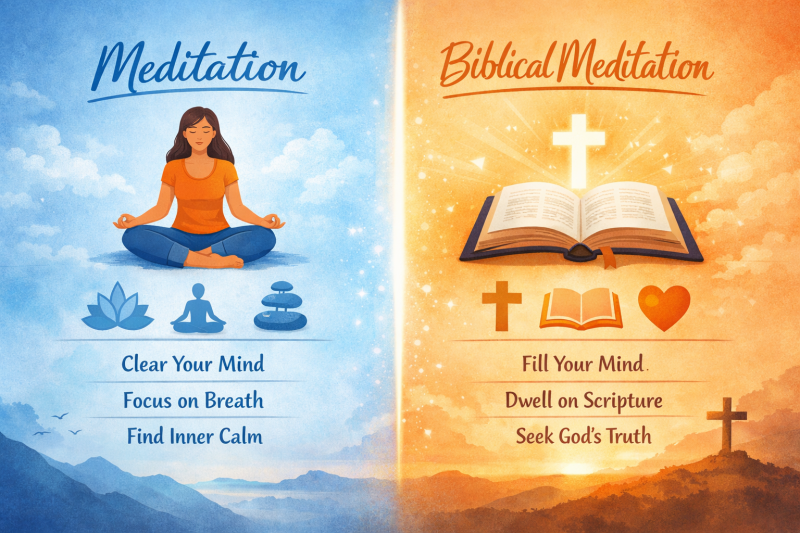
What’s the Difference?
Meditation has become a popular wellness practice in today’s world. From reducing stress to improving focus, many people are turning to meditation to find peace in the midst of busy lives. But did you know that the Bible also talks about meditation?
While biblical meditation and traditional meditation may appear similar on the surface, they have very different foundations, purposes, and outcomes.
Traditional Meditation: Emptying the Mind
Many forms of traditional meditation encourage individuals to quiet or empty the mind. The goal is often to detach from thoughts, emotions, and external distractions in order to achieve a state of calm, mindfulness, or self-awareness.
Practices may include:
- Focusing on the breath
- Repeating a mantra
- Observing thoughts without judgment
- Seeking inner peace through stillness
These practices can offer temporary relaxation and stress relief. However, the focus remains primarily inward, centered on the self and one’s own experience.
Biblical Meditation: Filling the Mind
Biblical meditation takes a different approach. Rather than emptying the mind, Scripture encourages us to fill our minds with God’s truth.
Psalm 1:2 describes the blessed person as one whose “delight is in the law of the Lord, and who meditates on his law day and night.”
Biblical meditation involves:
- Reflecting on Scripture
- Thinking deeply about God’s character
- Pondering His promises
- Listening for His guidance
- Aligning our thoughts with His truth
The goal is not simply relaxation but transformation.
The Key Difference
Traditional meditation often asks, “How can I find peace within myself?”
Biblical meditation asks, “How can I draw closer to God and allow His truth to shape my life?”
One seeks peace by looking inward. The other finds peace by looking upward.
Why It Matters
Our thoughts shape our lives. When we continually meditate on God’s Word, we begin to see our circumstances through His perspective rather than our own fears and emotions.
Isaiah 26:3 reminds us:
“You will keep in perfect peace those whose minds are steadfast, because they trust in You.”
The goal of biblical meditation isn’t to silence every thought; it’s to intentionally focus our thoughts on the One who never changes.
A Simple Practice
Choose a short Bible verse. Read it slowly several times. Ask yourself:
- What does this teach me about God?
- What does this reveal about my life?
- How can I apply it today?
Carry that verse with you throughout the day, returning to it whenever your mind begins to wander.
The result isn’t an empty mind, but a renewed mind—one that becomes increasingly aligned with God’s heart, His wisdom, and His peace.